It's a … just a frog?
OK, so what's that supposed to mean? Well ... read on! ...
This is a short essay about the “clip-in” or “fixed” frog. All my baroque bows are made with a clip-in frog - partly because I simply prefer it, but mainly because it's historically appropriate. And it sounds better! So, what exactly IS a clip in frog, why is it such a big deal, and how should one deal with it?
For those who just want to get to the point, I've put a video on YouTube, showing how to remove and replace a clip-in frog safely, and also how to adjust the tension of the hair by the (relatively) simple means of putting some leather or a piece of gut-string between the hair and the back of the frog.
But that's not all that this essay is about. There's some background, some history ... and (big announcement) a new proposal for the tensioning issue …
But first, an answer to the question above - what is a clip-in or fixed frog? Exactly as the name suggests, it is a frog that clips in (on?) to the bow at a fixed place. A flat mortice, usually ending in more or less pointed V-shape is carved into the bow onto which the frog, the underside of which has the same profile, is placed. The pressure of the hair (which is attached to the stick at the far end of the mortice) holds the frog firmly in place, and the “v” prevents the frog from sliding forward.
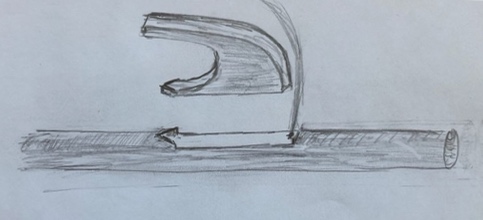
It's a very elegant, simple and secure system which has many advantages - simplicity and security for a start, but also for sound and handling. The hair is attached directly to the stick at the frog end - just like at the tip - so you have a mechanically robust set-up - hair firmly fixed to both ends of the bow.
This avoids potential unwanted vibrations from a system where the hair is attached to the frog, and the frog then attached to the bow. Given that the 'true' vibration of the bow is key to a good sound, it's clear that the fewer in-between-steps there are, the better. In terms of handling, the frog is, well, fixed, so there is never any change of balance, unlike with a screw frog, where the (relatively) heavy frog can move up to about 5 mm, which obviously affects the balance point.
There are two main disadvantages of a fixed frog. One is that removing or replacing the frog must be done with care to avoid damaging the "V" end of the mortice in the bow (check out my video). And the second is that the frog is, well (once again), fixed, so there is an issue with tensioning and releasing the hair. Historically there are two well-documented solutions. One is to use your thumb - placed under the hair just after the end of the frog - to enable you to tension the hair by pushing it towards the stick. Sort of what gambists do in reverse. I personally find this difficult - not the “thumb-under” grip, that I like a lot - but the placing of the thumb beyond the frog under the hair alone - for me it doesn't work at all when the hair is too slack, and I find it difficult to control the bow, it wobbles all over. The other solution is a little piece of leather or something similar - I often use a short length of a gut d- or g-string, which is relatively easy to insert and remove, (as shown in my video) between the hair and frog. The leather version is shown beautifully here in this detail from a painting by Abraham van den Tempel "David Leeuw with his Family", 1671.
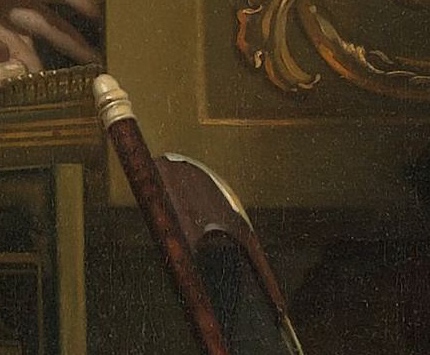
(You can see the whole painting here. )
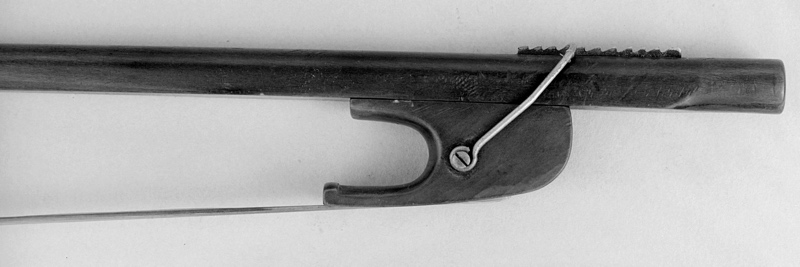
At some point in history, these simple methods for tensioning the hair became insufficient - possibly as the bow became longer, or the reverse camber became more prevalent (ie, moving towards classical bows) - and other strategies were invented. The crémaillère bow is one such - a slightly unwieldy system, and quite possibly more prevalent in the history books than in fact. But it's an interesting idea - a (usually) metal ratchet is inserted on top of the bow, over which passes a metal loop attached to the frog, enabling the frog to be held securely in discrete positions. Here's a picture of the mechanism on a rather extraordinary bow in the Musée de la Musique in Paris.
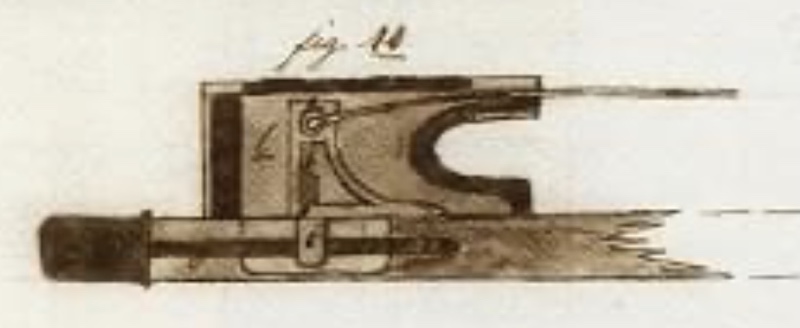
And then of course came the screw-frog (around the latter third of the 18th century?) which quickly won out over all the rest. Mind you, it wasn't so perfect that it was immediately adopted by all - and as late as the middle of the 19th century Vuillaume was experimenting in his self-rehairing bows with a system whereby the screw tightened the hair inside the frog, but didn't move the frog.
These days there are various systems in use that I know of. One is the actual (re-creation of the) crémaillère system. Another is based on a similar idea: a ratchet profile on the stick-mortise to lock with a matching profile on the underside of the frog - either carved (which is labour intensive and liable to wear), or glued-on plastic - which works very well, but offends my aesthetic sense. But both these systems have the disadvantage of a moving frog. Another system involves a semi-round wedge between the hair and the frog, held in place by friction - neat, but I have found this tends to slip. Another common solution is to have two (or more?) frogs appropriate for different conditions. This works well to cover substantial basic changes in humidity - a wet summer with over 70% relative humidity, to a dry centrally heated winter with around 30%. But it's not subtle, and does mean you have to get familiar with removing and replacing a frog safely (as shown in my video) .
Luis Emilio Rodriguez has invented a wonderfully elegant system, which he calls TrickTwig©, whereby a button at the end of the stick tightens the hair inside the stick. The frog stays put, and you have control over a fairly large range of hair tension. It's sort of like the Vuillaume system, except that the hair moves in the stick rather than the frog.
I myself have long wondered about 'mechanising' the tried and tested method of inserting something between the hair and the frog. During 2024 the ideas began to crystallise, I sold my first versions in 2025, and now (August 2026) with the help of my son Andreas from the engineering side, and technical and aesthetic refinements from my good friend Luis Emilio, I proudly announce this - a method by which you can adjust the hair tension by turning a small wheel in the frog:
It's a frog ...
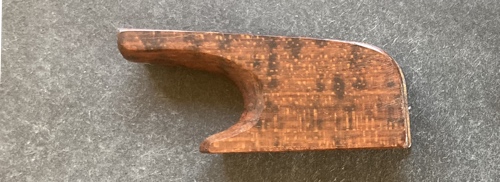
It's just a frog
It's “a-just-a-frog©"
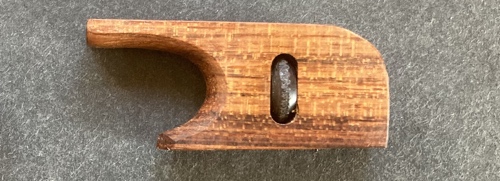
(Say it out aloud and you'll get the point!).
It's a slightly (!) finicky-to-make system; - a tiny wheel mounted vertically in the frog extends or retracts a little paddle horizontally, which pushes the hair out, or lets it back in. This should show you how it works:
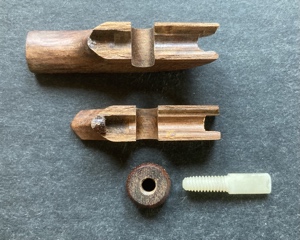
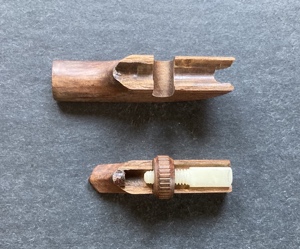
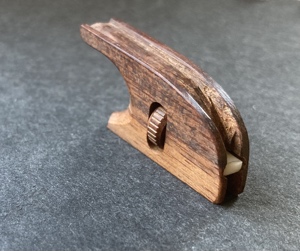
It's not fantastically robust (the screw threads are necessarily tiny), but as long as one doesn't attempt to screw in and out under tension, it works well. And if you're particularly sensitive to precise hair tension, then it's a very useful little system. It is literally an “Adjust-a-frog"